Monday, 3 June 2013

On tour in Bolivia: Days 4-5

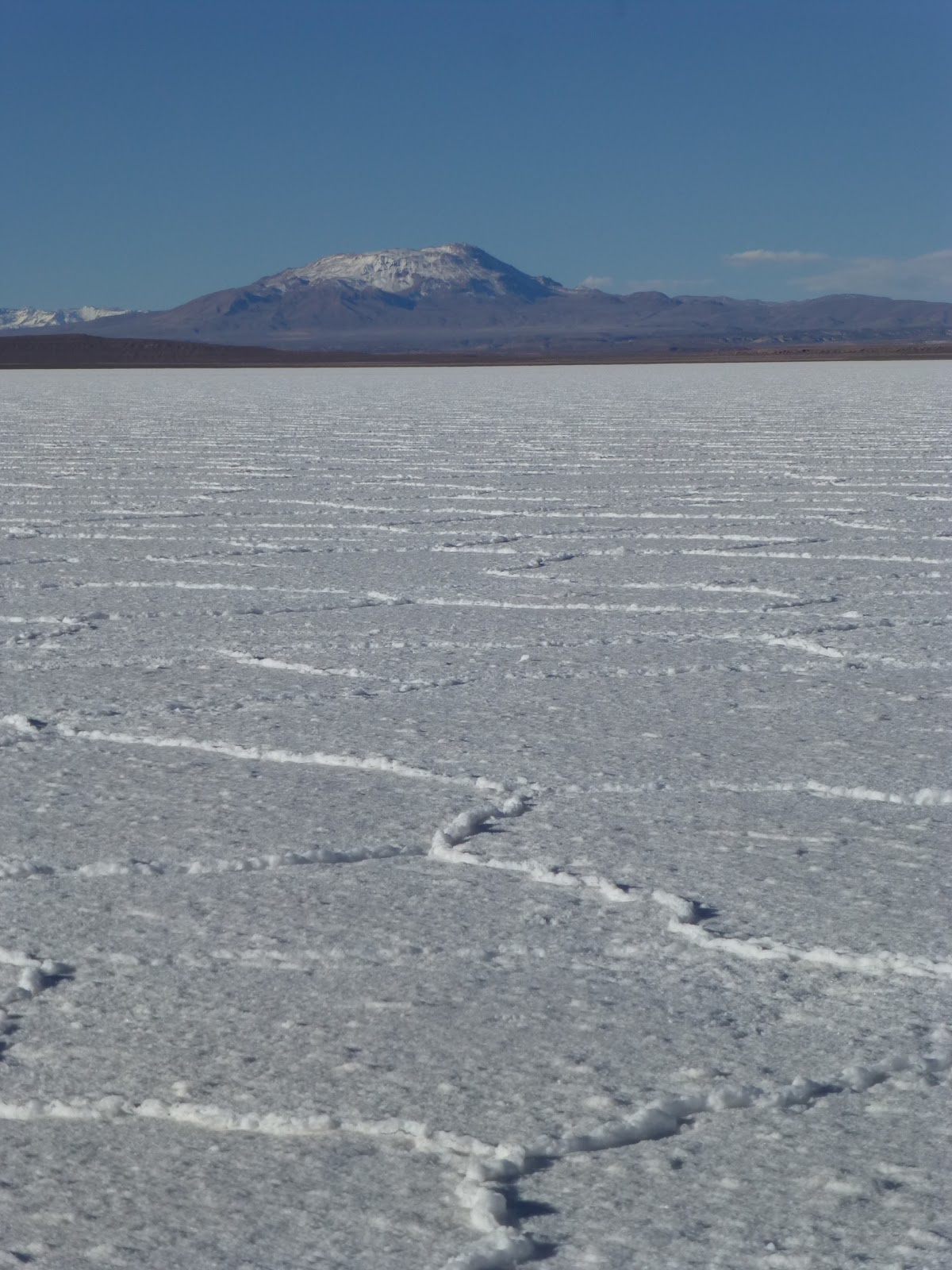
Our trip to the Salar de Uyuni had finally arrived! We had to wake up at 4.30 and we were on the road by 5 so that we could get to the salt flats for sunrise at 7. As we approached the salt flats it got increasingly cold - it´s about minus 20 at night! And we made it just in time, and wow, what a view - the sunlight created an orange-pink sparkly glow across the salt which was magical.


Then as the sun rose, we started to see how vast the slat flat was - all around for as far as the eye could see, there was just an enormous expanse of white salt. It was hard to get a sense of scale and perspective - and when we then drove to an island in the middle, it was hard to get to grips with how far away the island was. At the island we had breakfast and began to defrost as the sun warmed us up. We climbed up to a view point and by then the salt flats were a glistening white - otherwordly!


We then drove across the salt flats to Tunupa volcano. We had opted totrek up the volcano - we didn´t get to the top, which was 5,400m, but we managed enough to get good views down onto the salt flats, and to admire the colours of the volcano crater.


Then for another drive across the salt flats, with stops alongt thew way to admire natural holes in the surface, where you could see salt cristals. And plenty of time for silly photos!


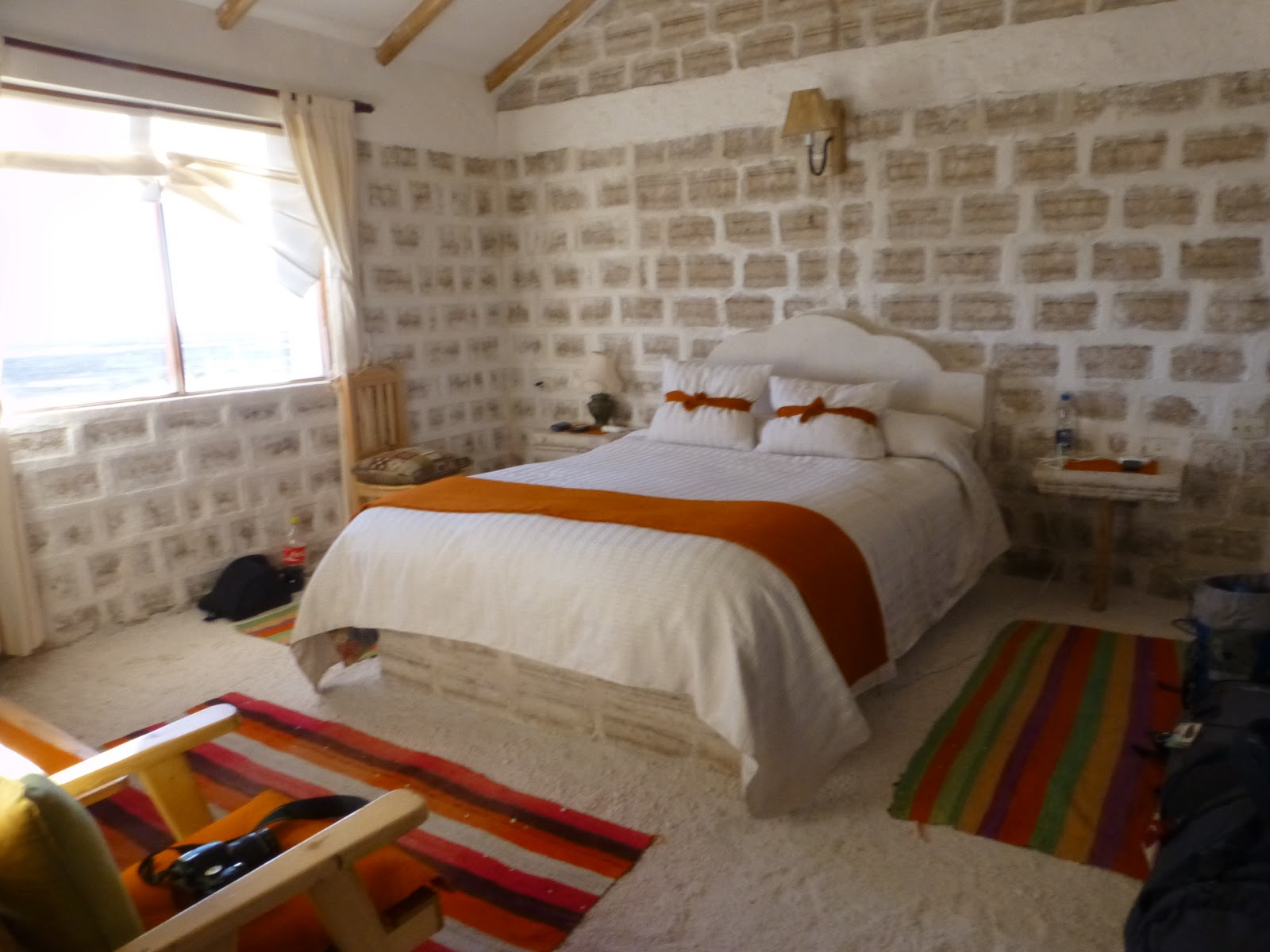
We ended up in Colchani, where we stayed the night in a salt hotal - the walls, beds, tables, and chairs were all made of salt. And the floors were salt cristals - not too comfortable when you want to get to the loo in the middle of the night!

The final day petered out a bit, with visits to see the piles of salt collected by the locals, a drive past the original salt hotel that´s now a museum, and a weird trip to the a train cemetary in Uyuni! After lunch we said goodbye to Hernan and Nancy and spent the rest of the day in Uyuni - not a very exciting place to say the least, but a bit of time to relax and prepare for our next adventure, travelling on through Bolivia by ourselves...

On tour in Bolivia: Days 1-3

Our five-day tour would take us north from Tupiza up into the Lipez mountains and then down into the far south-west corner of Bolivia through an area full of lakes and volcanoes, hot springs and geysers, then finally across the Salar de Uyuni - the biggest salt flats in the world - and ending in Uyuni where we would continue our journey through Bolivia ourselves. We set off with Hernan our driver and Nancy our English- speaking guide - English not fantastic but comprehensible most of the time. We had the back of a 4x4 to ourselves, so there was no fighting over window seats!


The first day was a lot of driving through gorges of yet more red rock, and up into the Lipez mountains - all on winding dirt tracks, and we had to quickly get used to the bumpy ride.


We stopped in one of the many deserted mining villages for lunch and we were relieved to be offered chicken, vegetables, and fruit, yum! Then as we climbed higher, it got much colder. By the time we reached our destination for our first night, it was freezing. Our hotel was in a very remote village in the middle of nowhere at 4,200m - and we were the only guests so it was a rather bizarre experience. We had to get up at 4 the next morning for an early departure though so we were in bed by 9 and there wouldn't have been time to enjoy a nice hotel anyway!


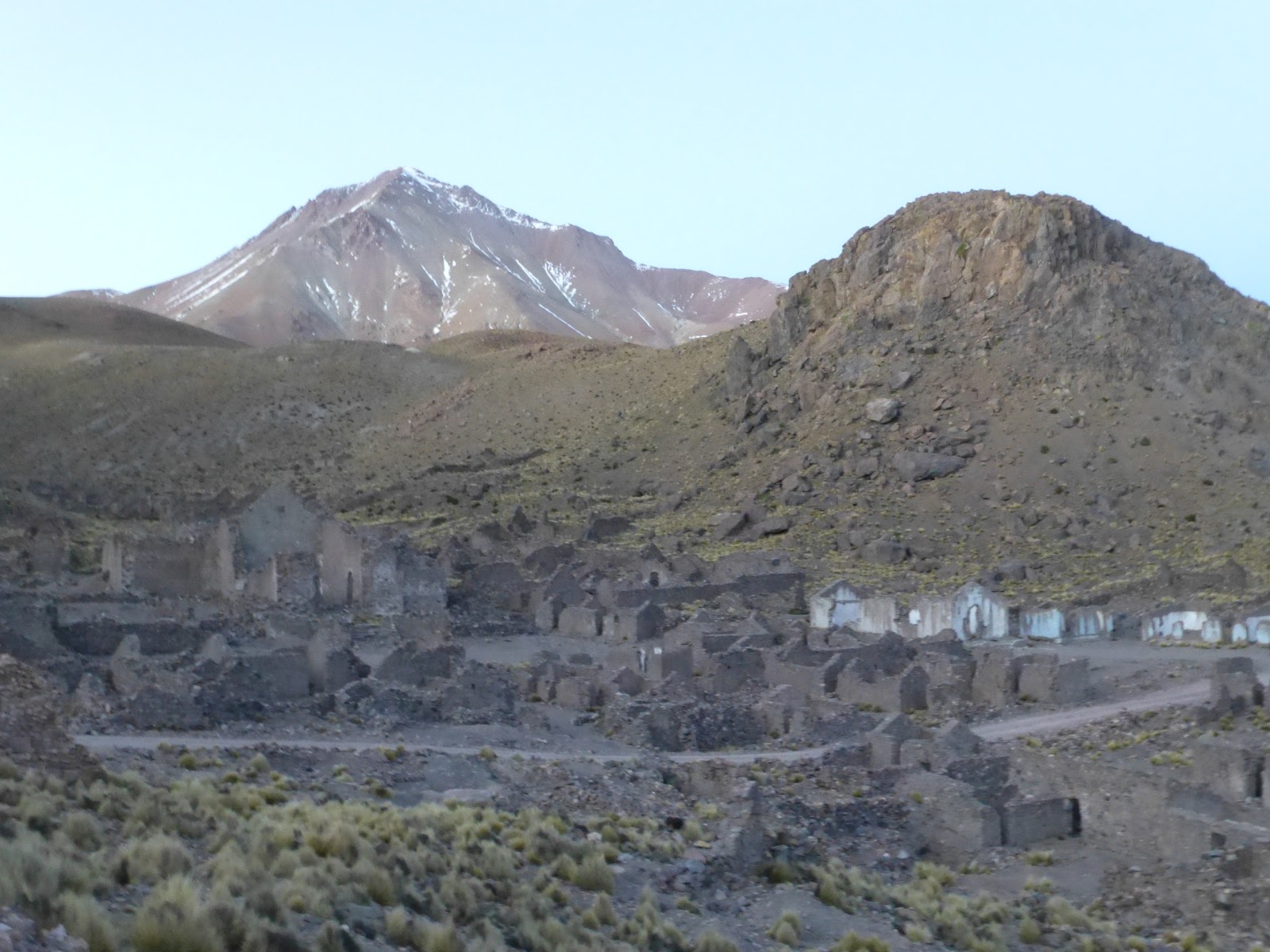
The next day started with a two-hour drive in the dark, getting even colder as we climbed up to 4,700m to visit the ruins of a colonial mining town - the highest town in the world in its time, but abandoned about 100 years ago and now only inhabited by Andean rabbits!

Then for a long but enjoyable day of fabulous scenery, driving through the national park with a backdrop of volcanoes, often stopping to admire lakes of different colours depending on the minerals they contain - some with flamingoes yet to migrate. Numerous llamas and cacti until it got too high for anything other than a hardy variety of grass and a bright green moss called yereta.


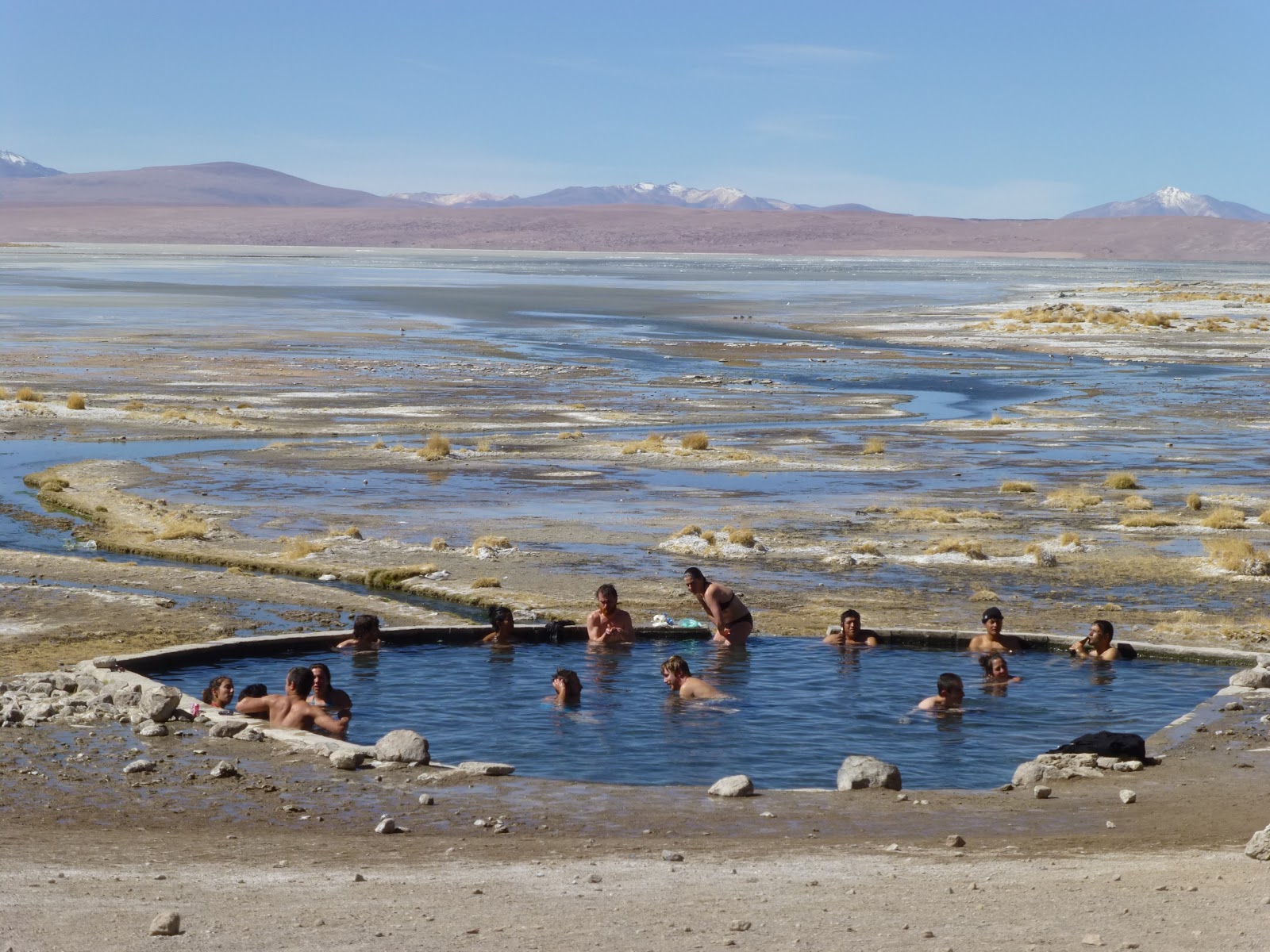
We stopped for lunch at some hot springs at well over 4,000m - and although it was windy and rather chilly we couldn't resist jumping into the pool of 35 degree water to enjoy the warmth and mountain views. Also because the hot springs in the Atacama desert where David and I first met were only just a few km away over the border into Chile, so it was nice to be back!


In the afternoon we climbed further, past yet more volcanoes and lakes. Two of our favourite lakes were Laguna Verde, a gorgeous turquoise colour - and Laguna Colorada, a surprising pink colour with flamingoes.


We reached our highest point so far at 5,000m, to see some geysers with boiling mud pools. Such a contrast of hot and cold!


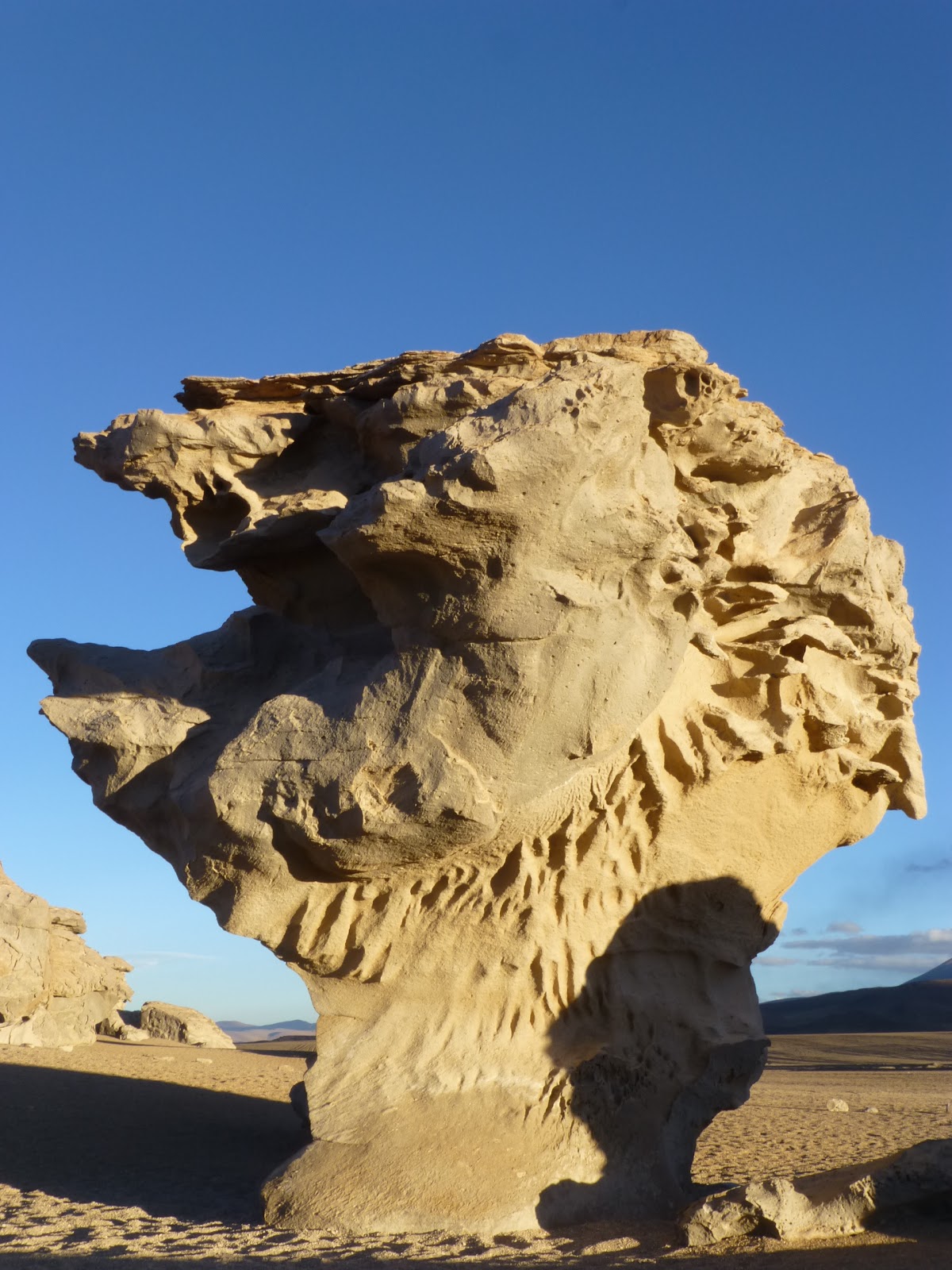
Then we dropped down and drove across the Siloli desert for several hours, past amazing petrified rock formations.


And finally, 14 hours after our very early start (!) we reached our hotel - in the middle of the desert - literally!


This hotel was much nicer and we had company, in fact it was full - there is nowhere else to stay after all! There was a big fire in the dining room - fuelled by small twigs and bushes as there is nothing else at this altitude. And there was fresh home-made bread with dinner. We celebrated the day with a local beer which at 4,600m may have been a mistake. We were in bed by 9.30 which was when the power went off!

The third day was a shorter one and we were allowed a lie-in until 7, what decadence!First through more desert and then past a series of lakes - the best two being Laguna Honda, a lovely heart-shaped frozen lake with flamingoes huddled in the middle of it - and Laguna Hedionada with a lot more flamingoes nearer the shore posing for photos.


We also managed to finally spot some Andean rabbits - called viscocha. They looked more like mini kangaroos to me, especially when they hopped around!


In the afternoon we left the lakes and headed for more volocanoes, including a semi-active one that is smoking - you can clearly see the smoke and scientists reckon it will erupt in about 20 years. So we were fairly safe!


We finished the day driving over a small salt-flat but it wasn´t very spectacular as it was only partly salt - it just looked like mud to me, but the llamas liked it as there was some water!

Into Bolivia

We reached the end of Argentina at La Quiaca. It's truly the end of the line - there's not a lot to keep you there before crossing into Bolivia! But we had decided to spend the night there to give us plenty of time the next day to get across the border and onto another bus. We found a restaurant that served beef so we could have one last Argentinian beef steak and malbec. Thank goodness for that malbec as the beef was not up to its usual standards - animals not fed so well up here in the mountains!

We didn't get much sleep as the locals were partying into the early hours - in celebration of Independence Day the next day. And there were yet more celebrations the next morning when we staggered out for breakfast - everyone was heading for the square, dressed in their smart clothes or uniforms. And as we left for the border the band was playing and various dignitaries were giving speeches - quite a send-off!


Crossing into Bolivia was very straightforward - the Bolivian policeman sang YMCA as he checked and stamped our passports. Then we walked across the bridge and into Villazon, and up the main street past loads of dodgy looking money exchange kiosks. Lots more people than in La Quiaca and already a very different feel - relaxed and colourful. We changed some money at a proper bank and then managed to get a bus to Tupiza almost immediately. I'm not sure where the bus was heading exactly but they said they could take us to Tupiza so on we got - along with a load of other people, luggage and boxes.
It took about two hours to get to Tupiza, driving through yet more rugged rocky scenery, and with herds of goats and plenty of llamas along the way. Tupiza is a small town nestled amongst red rock. We spent the afternoon relaxing in the hotel which was surprisingly nice, and we finally got to meet Gladis who we'd been emailing about the tour. We managed a walk up to a viewpoint to enjoy the red rocks at sunset, but the town didn't have much else to offer.


We couldn't even find an interesting place for dinner - most of the restaurants were pizzerias and we had already had enough of Argentinian pizzas! Hoping for some more interesting Bolivian food on our tour...

Saturday, 25 May 2013

Driving in Argentina

We hired a car for five days - driving in Argentina is quite an experience! We started out from Salta and David bravely did the first stint of driving out of the city. There were very few road signs and the road was full of pot holes; fortunately it was a Sunday morning and very quiet, but there were still enough crazy drivers around to make driving quite a challenge! Once out of the city and on more country roads, it was much more relaxing. I took over once things got quieter, only to run out of tarmac fairly quickly! Driving on gravel was interesting, and I soon found myself driving up hairpin bends to the top of a pass, up through the enchanted valley, where we got some great views of the surrounding countryside - rolling hills with cacti, and more coloured rock formations pushing up from the ground in all directions.


We drove on to Cachi where we stayed the night - a lovely colonial town out in the middle of nowhere, with snowcapped mountains as a backdrop. Here is the view from the window...


The next day we drove for five hours on gravel or 'ripio' - we had wondered how we´d cope, but we both really enjoyed it. You soon get used to the bumpy surface, and it meant we could drive down through the Calchaquies valley - past yet more rugged landscapes, with amazing rock formations. I think we´re going to take up rally driving when we get back!


We eventually reached Cafayate where we stayed two nights. This is a small town right in the heart of the wine growing area, surrounded by vineyards, with the vines going a lovely autumnal colour. Back on tarmac now, we spent a day visiting some nearby pre-inca ruins at Quilmes - once a town of 6,000 indigenous people, eventually wiped out by the Spanish. Although interesting, we could have done with a bit more info on what we were looking at! A visit to a nearby museum afterwards helped a bit.


The next day, we drove back to Salta via the Quebrada de las Conches - an amazing gorge, where at every turn, you find yet more views of different coloured rocks and formations. It took us hours to drive throughout as there were so many photo opportunities!


We then stayed to the north of Salta, in San Lorenzo, for the last two nights with the car. It´s a pleasant place but we weren´t really there long enough to explore the surrounding countryside.

Up early the next morning, so we could head north to Purmamarca and Tilcara. We headed first for Tilcara and visited another pre-Inca settlement, which was similar to but better organised than Quilmes. Up here inthe mountains it feels very different as most people are indigenous and lifestyle is very rural. We then headed for Purmamarca - a village with a stunning backdrop of the hill of seven colours - you guessed it, yet more coloured rocks! We walked around the hill and the early evening light really brought out the red and orange colours.


Then for a long drive back, delayed by the road being closed because of filming, and the last few hours drive back in the dark were very scary - David drove, and I gripped the door handle as tight as I could! We´d been fine during the day, but at night when you`re not sure where you´re going, with very few road signs and some very agressive Argentinian drivers, it´s a very different experience.

The next morning we returned the car in one piece, and took a bus to La Quiaca where we would cross into Bolivia. Ah, so nice to be back on a bus... hmmm!

Wednesday, 22 May 2013

Salta and the Tren a las Nubes

Salta
We had two days in Salta - one of the best preserved colonial towns in Argentina. We arrived early evening and began our stay with a stroll through the main plaza with its ornate pink cathedral. And thanks to Lonely Planet we found a great restaurant with very delicious beef.

The following day we explored the city - it's not huge and is easy to do on foot - and by cable car to get good views down onto the city.


In the evening we enjoyed another great meal, this time a bit further out in more of a locals restaurant, where we shared a portion of filet mignon which was more than enough for the two of us!


Tren a las Nubes
On our last day in Salta we had pre-booked tickets to take the Tren a las Nubes up into the Andes. This is a tourist train that only runs on Saturdays, so we had carefully planned our trip to coincide with this. We had to be at the station by 6am and we set off at 7am - and we steadily climbed up to 4,200m way up in the Andes.


As the train chugged up the tiny tracks, we were served snacks, and were given information about the places we passed and what to look out for. There were of course numerous photo opportunities and the weather behaved for us, with blue skies and sunshine. We started out in lush cloud forests and then gradually the trees and bushes diminished leaving only rocks and cacti, and eventually only rocks. We got some great views of snowy peaks over 5,000m, and even I got quite excited about the engineering involved in building a railway track in this terrain - including a viaduct at 4,200m at the end of our journey, near the Chilean border.


We took the bus down, arriving back in Salta at about 9.30 - it would have taken two more hours to go back by train. A very long day, but worth it for the experience!